When an idea comes to us from different directions, the universe has a message for us. In the last few days, the idea that joy is a practice, rather than a hoped-for feeling, has come to me.
From one direction, my dear friend, Carl “Skye” McColman, recently wrote a piece on his Substack about the duty of joy. He quotes Dorothy Day:
It is not easy always to be joyful, to keep in mind the duty of delight.
and C. S. Lewis:
It is a Christian duty, as you know, for everyone to be as happy as [they] can.
From a second direction, I woke up early one morning and, as is my wont, I listened to a podcast to ease me back to sleep. This time, it was a recent talk by Tara Brach. She has given a series of talks on the Four Immeasurables or divine abodes, which are foundational Buddhist virtues: loving-kindness, compassion, sympathetic joy, and equanimity. The talk I listened to was the one on Joy. She shares a quote that has been with her over the years by André Gide:
Know that joy is rarer, more difficult, more beautiful than sadness.
Once you make this all-important discovery, you must embrace joy as a moral obligation.
And so, I lay in bed, comfy and warm in the envelope of duvet and mattress and Tara’s talk, and gave myself unto the joy of rest.
As Skye says, we’re not terribly keen on the words ‘duty’ and ‘obligation’. They seem to be the antithesis of joy. The point he makes is that none of us is an individual, cut off from the body of relationship, community, and society. How I am affects how you are. Joy, like misery, is contagious. Therefore, I have a responsibility, duty, or obligation to cultivate joy.
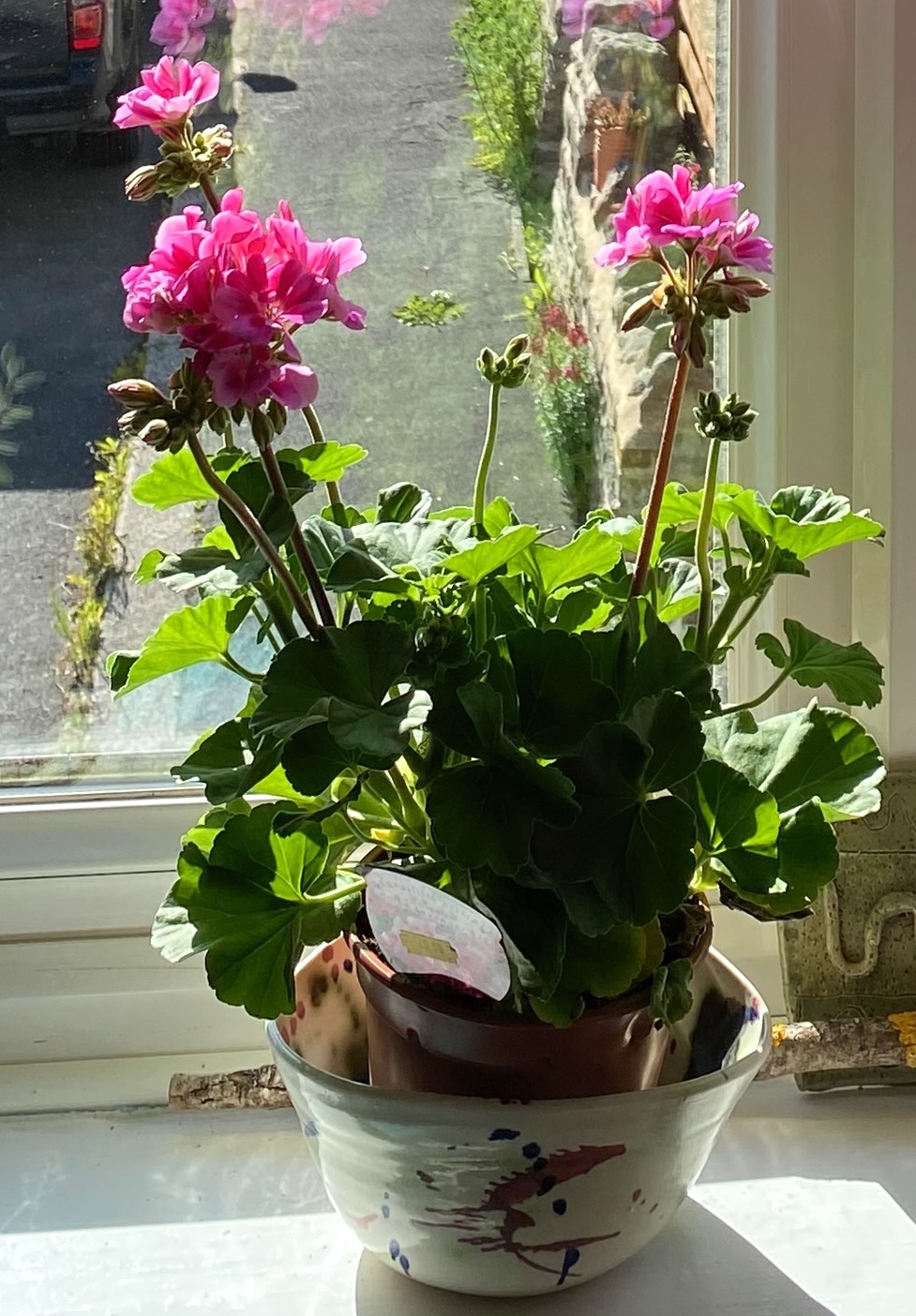
This idea has been working its magic on me. Early one morning, I sat in my little study, where I have an altar covered in stones, artefacts, an icon of Christ Pantocrator, a small statue of the Buddha, a linocut print made by my daughter, and pictures of my parents, grandparents, daughters, and myself as a baby. On my windowsill are some plants, including a geranium with variegated pink flowers that I bought on Wednesday. I looked at it all and allowed the pleasure of this community of beings and remembrance to build in me. It was simple and easy. My heart opened. I felt filled with goodness. This is prayer.
I often turn up to pray with an unspoken, subconscious question: How can I improve? How can I fix myself? Implicit is the sense that there is something wrong with me. I am not enough, good enough, or worthy. Please mend my life! This morning, something different happened. I enjoyed being in this room with these things. It was a simple shift, requiring no cleverness or great spiritual achievement, merely a change of mind and heart.
It turns out that joy is a choice.
Let me be clear about what I mean. I don’t mean ignoring or, worse, squashing difficult feelings, such as sadness, anger, and shame. These feelings should be given space, airtime, and kindness.
I mean that I (we) have a default way of looking at the world, which is often based on fear, caution, and vigilance rather than curiosity, enjoyment, and enthusiasm.
(There is an evolutionary account of this, by which our brain has a ‘negativity bias’: Am I going to be food rather than have food?
There is an attachment theory account of this: The quality of attachments with caregivers when I was a child is internalised into a working model of the world.
There is Thomas Keating’s account, which he calls our emotional programme for happiness: Am I safe? Am I loved and valued? Do I have agency?
Each account offers a different perspective on our anxious vigilance and lack of joy. None is a life sentence.)
The choice for joy is as subtle a turn of the head, a refocusing of the gaze: from a please-sort-me-out mentality to a gratitude mentality; from ideas of progress, production, and achievement, to already having arrived at life; from the inbox on my desk to the plant flowering on the windowsill.
This turn, this conversion, is from the past (rumination) or the future (planning) to the present (presence) – to this body present on this chair in this room looking out of this window at this moment.
Joy is a practice. I can choose it.
It was joyful to wake up and find your writing in my inbox – it’s been a while!
Lovely! Thanks for sharing this.
I really resonate with the connection of joy and cultivating a gratitude mentality.
The Principles of the Society of Saint Francis : JOY
_________________________________________________
‘The brothers and sisters, rejoicing in the Lord always, show in their lives the grace and beauty of divine joy. They remember that we follow the Son of Man, who came eating and drinking, who loved the birds and the flowers, who blessed little children, who was a friend to tax collectors and sinners and who sat at the tables of both the rich and the poor. They delight in fun and laughter, rejoicing in God’s world. They mix freely with all people, ready to bind up the broken-hearted and to bring joy into the lives of others. They carry within them an inner peace and happiness, which others may perceive, even if they do not know its source.
This joy is a divine gift, coming from union with God in Christ. It is still there even in times of darkness and difficulty, giving cheerful courage in the face of disappointment, and an inward serenity and confidence through sickness and suffering. Those who possess it can rejoice in weakness, insults, hardships, and persecutions for Christ’s sake; for when we are weak, then we are strong.’
_________________________________________________
(Thomas Aquinas argued that joy is an effect or fruit of the theological virtue of charity (love). In this view, when you possess true love for God and others, joy is the natural, inevitable result – Summa Theologiae, specifically Part II-II, Question 28. Joy and sorrow both proceed from love, but in opposite ways. Joy is the natural result of love because it arises when we are united with what we love, or when we see the “proper good” of the one we love enduring and prospering.)
I read this with a smile on my face the whole time. How good to have that please-sort-me-out mentality named. Letting it drop feels so organically holy. Then grief wells up that we (I) don’t live in that constantly – and here we go again!